The big question is, are IPTV subscriptions legal? The answer doesn't have anything to do with the technology itself, but everything to do with licensing and copyright.
Think of it like this: a legal IPTV service is like your local cable company. They pay for the rights to broadcast every channel they offer. An illegal one, on the other hand, is basically pirating the content without paying a dime. The real difference always boils down to whether the provider has legally acquired the rights to show you that programming.
At its heart, IPTV (Internet Protocol Television) is just a way to send TV content over an internet connection. The tech is perfectly legal and neutral. But whether a specific service is on the right side of the law depends entirely on if it has the proper licenses from the content owners.
Here’s a simple analogy: A movie theater is a legal business because it pays studios for the right to show their films. Someone on a street corner selling bootleg copies of those same movies? That’s illegal because they have no permission. IPTV services fall squarely into one of these two camps, and knowing which is which is key to protecting yourself.
This isn't a small corner of the internet, either. The global IPTV market is expected to balloon to around $269.9 billion by 2027. Most of that growth comes from legitimate, by-the-book services. The trouble is, the unauthorized providers who illegally rebroadcast content create massive legal risks—not just for themselves, but for their users, too.
To make it even clearer, let's break down the key differences between a legitimate provider and a shady one. This table should help you spot the red flags instantly.
| Feature | Legal IPTV Service | Illegal IPTV Service |
|---|---|---|
| Price | Reasonable monthly fees (similar to other streaming services) | Shockingly low prices (e.g., $10-$20/month for everything) |
| Channel Selection | A curated list of licensed channels, often region-specific | Thousands of global premium channels, including PPV events |
| Payment Methods | Standard credit/debit cards, PayPal | Often requests cryptocurrency, gift cards, or untraceable methods |
| Official Presence | Has an app in major app stores (Google Play, Apple App Store) | Requires you to "sideload" an app or use a generic player |
| Customer Support | Professional support via official channels (email, phone, chat) | Often uses informal channels like Discord or Telegram |
| Website/Branding | Professional website, clear terms of service, and contact info | Poorly designed website with vague or missing information |
As you can see, the signs are usually there if you know what to look for. The "too good to be true" offers are almost always a giveaway.
Every single TV show, movie, or live sports game is protected by copyright. For any service to legally stream that content, it has to sign a licensing agreement with the copyright holder. This is a complicated and very expensive process, which is exactly why legitimate services charge what they do and might have smaller channel lineups than their illegal competitors.
The crucial takeaway is this: If a service offers thousands of premium channels from around the world for a price that seems too good to be true, it almost certainly is. These providers are not paying for content licenses, which places them—and potentially their subscribers—in violation of copyright laws.
The image below gives you a snapshot of how legal IPTV services often compare to old-school cable when it comes to cost, channel options, and features.
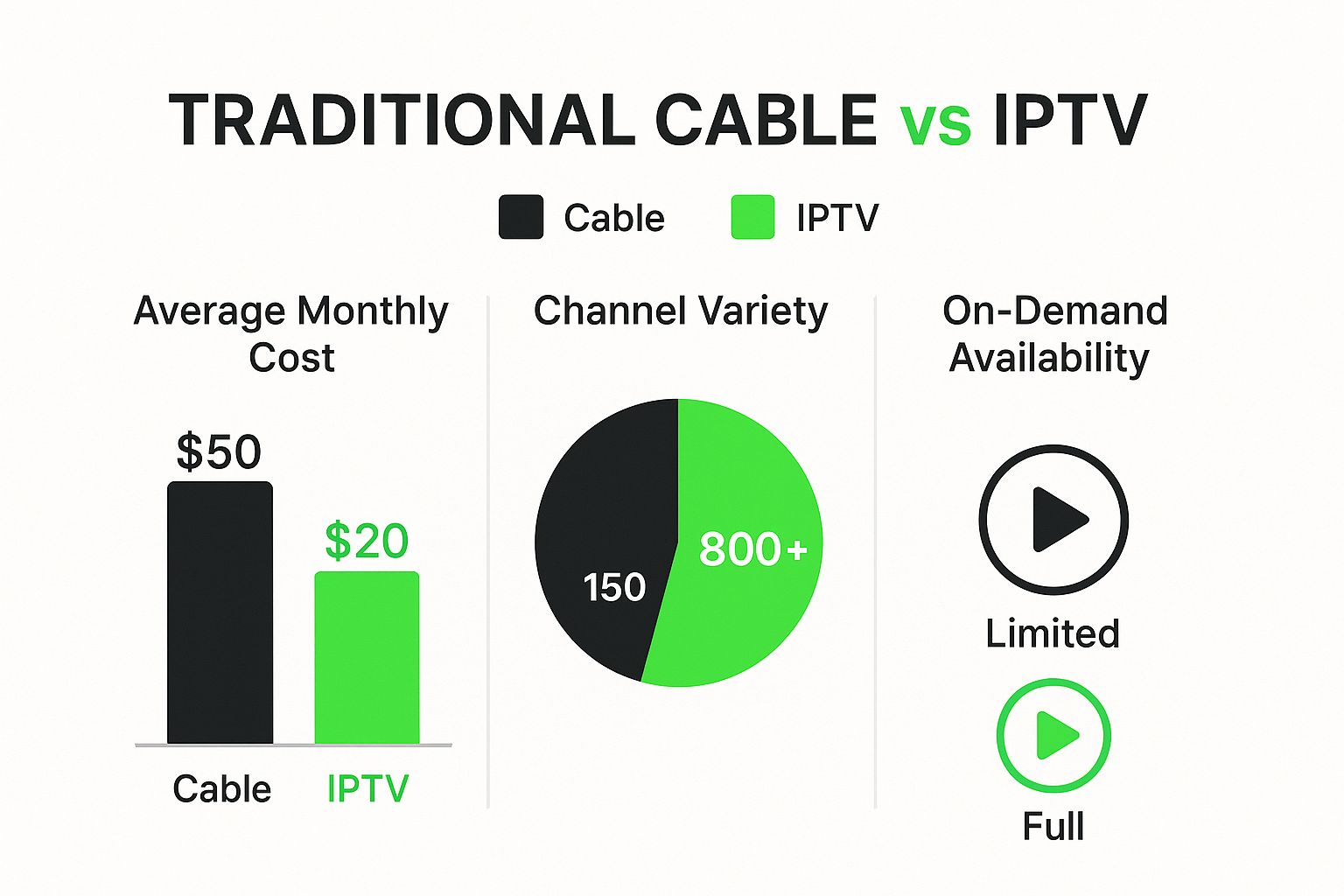
The data really highlights IPTV's appeal. You often get a much bigger channel selection for a lower monthly price, which is why so many people are making the switch.
If you're curious and want to get a better handle on the technology behind it all, check out our detailed guide on what IPTV is and how it works. While you definitely need to be cautious, the benefits of finding a good, legitimate service are crystal clear.
Dipping your toes into the world of IPTV can sometimes feel like you're navigating a wild, unregulated market. But don't worry, there are some dead giveaways that can help you tell a legitimate service from a shady one. Think of these as red flags—if you see them, it’s best to steer clear.
Knowing what to look for is the key to having a safe and legal IPTV subscription experience and avoiding potential headaches down the road.
The biggest and most obvious warning sign? The price. If a service is dangling thousands of premium channels from every corner of the globe, including live pay-per-view events, for pocket change, something’s not right. Legal providers have to pay some seriously hefty licensing fees for the content they broadcast, and that cost is always reflected in their prices.
A service offering the entire world of television for $10-$20 per month is a massive red flag. Those rock-bottom prices are only possible because the operators are pirating the content, not paying for it.
Illegal IPTV services love to bait the hook with promises of an impossibly huge channel library. It's common to see them advertise 10,000+ channels, boasting every premium sports package, international network, and brand-new movie you can think of.
On the flip side, legitimate services have carefully curated, and often region-specific, channel lineups. This is because their offerings are based on the licensing deals they've managed to secure. They simply can't legally bundle every channel from every country into one cheap package. If the channel list looks more like a fantasy wish list than a realistic TV package, it's time to get skeptical.
Here's a simple rule of thumb: If a provider is offering content they have no believable way of licensing, especially for a tiny fraction of the market price, you're almost certainly looking at an unlicensed stream.
This is a huge factor when figuring out if an IPTV subscription is legal. It’s also worth remembering that these illegal services are notoriously unreliable; channels often vanish without warning as their pirated sources get shut down. For a more stable setup, you can learn how to watch IPTV online for free using a legitimate player with your own M3U playlists.
You can tell a lot about a company by how it asks for your money. Reputable businesses provide standard, traceable payment methods like credit cards, debit cards, and PayPal.
Illegal outfits, on the other hand, tend to lurk in the shadows. They much prefer untraceable payment methods to dodge the watchful eyes of banks and authorities.
Be on high alert if a provider only accepts payments through:
This shady financial behavior usually goes hand-in-hand with a general lack of transparency. An illegal service often has a poorly designed website riddled with spelling mistakes, no listed physical address, no official company info, and no clear terms of service.
Another major giveaway is how you actually get the service onto your device. Legal IPTV providers like Sling TV, YouTube TV, and Hulu spend time and money developing professional, secure apps that get vetted and approved for the major app stores.
You’ll easily find their apps on:
Illegal services can’t get their apps onto these official platforms. They'd be booted immediately for copyright infringement. Instead, they force users to "sideload" an unverified app (usually an APK file) or use a generic third-party player. This process of sideloading can open up your device to malware and other security threats.
That unbelievably cheap IPTV deal often comes with hidden costs, and they can be pretty steep. When you venture into the world of unlicensed services, you're exposing yourself to some serious blowback that goes way beyond a flickering screen. Knowing these dangers is the first step toward making a smarter, safer choice for your entertainment.
The risks aren't just hypotheticals, either. They fall into three distinct and damaging buckets: legal repercussions, cybersecurity threats, and just plain bad service. Choosing an unlicensed provider is a gamble where the odds are stacked against you from the start.
While the big legal guns are usually aimed at the people running these illegal IPTV operations, the end-users aren't completely off the hook. In many places, the laws are shifting to hold subscribers accountable, too. This means simply streaming from an unauthorized source could land you in hot water.
The legal risks are no joke. In countries like the UK and across the EU, laws such as the Digital Economy Act give authorities the power to hand out fines or even jail time. You can dig deeper into the global market and its legal frameworks in this detailed analysis. While legitimate IPTV subscriptions typically run from $10 to $35 per month, the low prices of illegal services come with a heavy side of legal and security risks.
The bottom line is that playing dumb isn't a valid defense. When you use a service that's breaking copyright law—even as a paying customer—you could face anything from a warning letter from your ISP to hefty fines, all depending on where you live.
When you sign up for an unlicensed IPTV service, you're not just risking legal trouble; you're basically rolling out the welcome mat for cybercriminals. These services operate in the shadowy corners of the internet with zero accountability for keeping your data safe.
A huge weak spot is the custom apps they often make you "sideload." Since these apps skip the vetting process of official stores like Google Play or the Apple App Store, they can be packed with all sorts of nasty software.
Here's a look at the most common cybersecurity traps:
Protecting your home network is a must. A solid router with built-in security features, like the TP-Link AX1800 WiFi 6 Router, can act as a great first line of defense against these digital intruders.
Putting aside the legal and security nightmares for a moment, there’s a much more immediate and frustrating issue: illegal IPTV services are incredibly unreliable. That "too good to be true" price tag almost always means sacrificing a stable, enjoyable viewing experience.
You're paying for a service that comes with no guarantees, no customer support, and no one to answer to. When things inevitably go wrong, you're on your own.
Here are some of the classic headaches:
Instead of dealing with these constant frustrations, going with a legitimate provider is the only sensible move. For a secure and reliable experience, a vetted service like IPTV Now offers a stable platform without all the baggage. Making the switch means your entertainment is both enjoyable and worry-free.
Diving into the world of IPTV can feel like navigating a maze. With so many services popping up, how do you find one that's safe, reliable, and won't land you in hot water? It’s actually not as tough as it looks.
The secret is knowing the difference between a professional, law-abiding company and a shady operation. Once you know what to look for, the red flags become impossible to miss.
Your first move is simple: check out their website. A real company puts effort into its online storefront. You should find a clean, professional website with clear pricing, detailed terms of service, and a privacy policy that’s easy to find. These aren't just formalities; they show the company is transparent and stands by its service.
Think about the big names like Sling TV or YouTube TV. Their websites are slick, their subscription plans are laid out plainly, and they offer real customer support. That level of polish is a huge clue that they're legit.
On the flip side, an illegal service often has a messy, ad-plastered website with wild promises and zero contact info. It just feels unprofessional.
But here's the real acid test: check the official app stores. Legitimate providers jump through all sorts of hoops to get their apps approved and listed.
Make sure the provider has an official app on:
If a service tells you to download an app from some random website or "sideload" a file they send you, run the other way. That’s a massive red flag. Official app stores vet everything for security and legitimacy, and illegal services can't pass that test.
Don't just take the company's word for it—see what other people are saying. Look for reviews on trusted tech sites, check out forums like Reddit, and see what users are posting on consumer review platforms. You want to hear from real people about stream quality, channel stability, and how the company handles problems.
A couple of bad reviews are normal for any business. But if you see a flood of complaints about the service suddenly dying, channels vanishing, or shady billing practices, you're likely looking at an illegal fly-by-night operation.
Doing this homework helps you build a full picture, ensuring your choice of a legal IPTV subscription is a smart one. For more tips on this, feel free to browse our articles on other legal streaming websites that play by the rules.
Once you've picked a great service, the right hardware can make all the difference. A rock-solid stream deserves a setup that won't let it down with lag, buffering, or weird compatibility glitches. A few smart investments can seriously upgrade your viewing experience.
You don't need a complicated home theater. All it takes are a couple of key pieces to make sure modern, high-definition content plays smoothly.
Here are a few essentials for a top-tier streaming setup:
By carefully vetting your provider and grabbing the right gear, you can build a legal streaming hub that's both reliable and a joy to use. This thoughtful approach gives you peace of mind and an awesome entertainment setup for years to come.
So, you’ve found a legitimate, high-quality, and legal IPTV subscription. Awesome. But now comes the fun part: making sure your home setup can actually handle it. Your hardware is the bridge between that great service and a flawless picture on your screen. Getting the right gear from the start saves you from the headache of buffering, grainy streams, and choppy audio, turning your living room into the go-to spot for entertainment.
Think of it like building a race car. You wouldn't drop a monster engine into a car with cheap, worn-out tires and expect it to perform. In the same way, your top-tier IPTV service needs the right components to really shine. This is how you guarantee every movie night or big game is crystal clear and smooth as silk.
The streaming device is the brain of your whole operation. This little box or stick does all the heavy lifting—it grabs the signal from your internet, decodes the video, and sends it to your TV. A weak, underpowered device will choke on high-definition and 4K content, which means you'll be stuck with lag, freezes, and a whole lot of frustration.
To sidestep that mess, you need a device with a beefy processor and enough RAM to keep up. A couple of contenders consistently knock it out of the park and are perfect for a premium IPTV setup.
Picking a capable device is the single most important decision you'll make. If you're new to all this, our complete guide to creating a beginner-friendly streaming setup for IPTV is a great place to start.
Your shiny new streaming device is only as good as the internet connection it gets. That dreaded buffering wheel is almost always caused by Wi-Fi dead zones, a weak signal, or a congested router. The standard router your internet provider gives you often can't handle multiple HD streams spread across an entire house.
The solution? A rock-solid network foundation. If you're serious about smooth, uninterrupted streaming—especially in a larger home—a mesh Wi-Fi system is an absolute game-changer. These systems use multiple points to blanket your entire home in a strong, consistent signal.
A good mesh system makes sure the TV in the back bedroom gets the same great connection as the one in the living room. The Amazon eero 6+ mesh Wi-Fi system is a fantastic option that delivers true gigabit speeds and covers up to 4,500 sq. ft., killing those dead zones for good.
Okay, your stream is running perfectly. The final touch is making it look and sound incredible. Let's be honest, the built-in speakers on most modern TVs are pretty terrible. They produce flat, tinny audio that just doesn't do justice to a beautiful 4K picture. An external audio solution is a simple upgrade that makes a huge difference right away.
A soundbar is the easiest way to get immersive, room-filling sound without the hassle of a full surround sound system. The VIZIO V-Series 2.1 Home Theater Sound Bar is an amazing and affordable choice. It offers DTS Virtual:X for a cinematic audio experience and comes with a wireless subwoofer that delivers the deep bass your TV speakers can only dream of.
When you pair a great legal IPTV service with the right hardware, you’re not just watching TV—you're creating an entertainment experience that's secure, reliable, and genuinely captivating.
Even after laying out all the facts, the whole question of whether an IPTV subscription is legal can still feel a bit hazy. Let's clear the air by tackling the questions that pop up most often. Think of this as your final gut-check before you commit to a streaming setup.
These are the concerns we see time and again on forums and in community discussions. Getting straight answers is the only way to stream with total peace of mind.
Nope, not at all. IPTV (Internet Protocol Television) is just the method for sending TV shows over the internet instead of through old-school satellite dishes or cable lines. The technology itself is completely neutral and 100% legal.
Here’s an easy way to think about it: a car isn't illegal, but you can definitely use one for illegal stuff, like being a getaway driver. IPTV technology is the "car"—its legality is all about how the provider uses it. If a provider pays for the rights to show you content, they're driving legally. If they're just stealing and re-broadcasting content, they've gone rogue.
It all boils down to one word: licensing. That's it. A legal IPTV service, like YouTube TV or Sling TV, has jumped through the expensive and complicated hoops of getting broadcasting rights from the people who own the content (think ESPN, HBO, or your local news station). They pay a fee for every single channel they offer.
An illegal service just blows past that entire process. They grab broadcasts and stream them without asking for permission or paying a dime, which is a straight-up violation of copyright law. This is exactly why they can offer thousands of channels for pocket change—they have almost zero costs because they're stealing the product.
The core idea is simple: If the provider isn't paying the content creators, the service is illegal. This is the single most important factor in figuring out if your IPTV subscription is legit.
Yes, you absolutely can. While the big legal guns are usually aimed at the people running these pirate operations, the end-user isn't completely off the hook. The rules are always changing, and in many places, subscribers can (and do) face consequences.
Depending on where you live, the fallout could look like:
The risk is real, and claiming you "didn't know" won't hold up as an excuse. The smartest move is to stick with providers that are verified and operate above board.
Picking a legal provider is the biggest step you can take toward a secure setup, hands down. But you can add another layer of protection by using quality hardware. A solid streaming device like the Amazon Fire TV Stick 4K Max makes sure you're on a secure platform that gets regular updates. This keeps you safe from the malware often bundled into the sketchy apps you have to sideload for illegal services.
Once you get these key points, you can navigate the world of IPTV with confidence. The path to safe, reliable, and awesome-quality streaming always starts with choosing a service that plays by the rules and respects copyright.
At Free IPTV Player, we believe in giving you the tools and know-how for a fantastic streaming experience. For a verified and reliable legal IPTV service that brings stability and peace of mind, consider checking out our trusted partner, IPTV Now.