Live TV streaming is simply watching your favorite shows, news, and live sports over the internet, without the clunky cable box or satellite dish. It's real-time television, delivered right to your devices. This gives you the freedom to watch what you want, whenever and wherever you happen to be.
Remember how services like Netflix made your DVD collection obsolete? Live TV streaming is doing the exact same thing to your cable subscription. Instead of being locked into a physical connection and a rigid broadcast schedule, you get total flexibility.
We're talking about getting all that live content—the local news, the big game, that new network drama—as it's happening, but streamed directly through your internet connection. It’s a fundamental change in how we watch TV.
This isn't some niche trend anymore; it's the main event. By 2025, streaming has officially blown past traditional broadcast and cable TV viewership combined, now making up 44.8% of all TV time in the U.S. That's a staggering 71% jump in streaming viewership since just 2021, while the old guard continues to lose ground. You can read more about this historic TV milestone and see exactly how viewing habits have evolved.
Unlike on-demand platforms where you pick from a library, live TV streaming is all about the "now." It's the classic TV experience, just delivered in a smarter way. The key is its real-time nature; you're tuning into a channel's live broadcast the moment it goes on air.
So, what does that actually mean for you?
It’s a simple concept, really: you get the television experience you already know, but delivered more efficiently and with way more flexibility. It frees you from the living room couch and, more importantly, from that bloated monthly cable bill.
All you really need to jump in is a decent internet connection and a device to watch on. It could be a dedicated stick like an Amazon Fire TV Stick, your smart TV's built-in apps, or even just your web browser using a free online IPTV player like ours. Getting set up is surprisingly easy.
So, how does a live football game magically appear on your tablet seconds after the whistle blows? The secret sauce is a technology called IPTV, which stands for Internet Protocol Television. It’s the engine that truly powers modern live TV streaming.
Think of your favorite show as a high-priority package. The broadcaster acts as the sender, taking the live video feed and running it through an encoder. This process converts the show into a digital format and then breaks it down into thousands of tiny data packets.
These packets are then sent out over the internet—basically the world's biggest and busiest postal service. Along the way, powerful streaming servers act as distribution hubs, expertly routing each packet to make sure it gets to its destination quickly and efficiently. Your device, running an IPTV player, is the final mailbox. It catches these packets and instantly reassembles them into the seamless, high-quality video you see on your screen.
This whole delivery system is a finely tuned process built for speed and reliability. Every single step is critical to ensure you don't miss a moment of the action, whether it's a game-winning goal or breaking news. The main goal is to minimize delay, or what the pros call latency, so what you see is as close to real-time as possible.
This visual breaks down the three core stages of how live content gets from the source to your device.
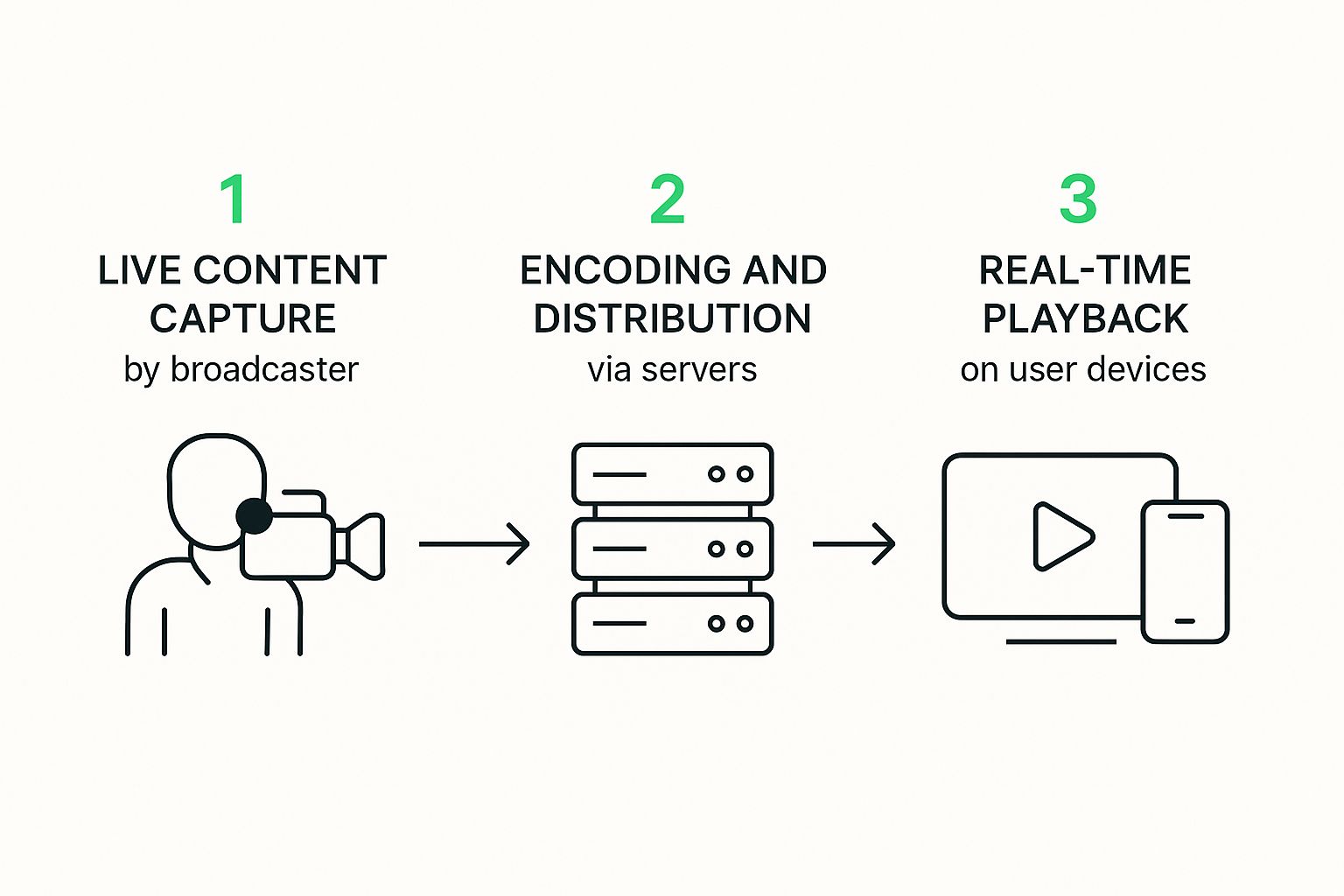
As the flow shows, the journey starts with capturing the live feed, then encoding and distributing it through a network, and finally, decoding it for playback on your end.
This sophisticated data delivery is what makes watching TV anywhere a reality. To pull off a high-quality live TV experience, providers often use advanced solutions for boosting bandwidth and reliability for live video streaming just to handle the immense amount of data involved.
The packet-based delivery of IPTV is incredibly efficient. Unlike traditional broadcasting that sends out one massive signal for everyone to catch, IPTV sends data directly to you only when you request it. This one-to-one connection is what allows for a more stable and personalized viewing experience.
Here’s a quick look at the key pieces of the puzzle:
The core idea is simple yet powerful: by using the internet's existing infrastructure, IPTV breaks free from the limitations of traditional cables and satellites. It transforms television into a flexible, on-demand service that works on your terms.
This system doesn't just deliver your scheduled live channels; it opens the door to a massive world of global content that was previously out of reach. All you need is a reliable internet connection and the right player to unlock it.
It's easy to get live TV streaming and on-demand streaming mixed up. After all, they both send shows and movies to your screen over the internet. But under the hood, they're completely different animals, and knowing the distinction is the secret to building an entertainment setup that actually works for you.
Think of it this way: live TV streaming is like a radio station. You tune in at a specific time to catch a broadcast exactly as it's happening. On the other hand, on-demand streaming—think Netflix or Disney+—is your personal media library. You get to pick what you want to watch, whenever you feel like it, from a massive catalog.
The biggest thing that sets them apart is scheduling and a sense of immediacy. Live TV streaming is all about what’s happening right now. It’s built for those can't-miss moments that just aren't the same if you see them later, like the Super Bowl, the season finale of your favorite show, or breaking news alerts.
On-demand services are the complete opposite. They're designed for pure convenience and binge-watching marathons. Their entire library is ready to go 24/7, putting you in total command of your viewing schedule. If you want to dive deeper into the tech that makes this possible, our guide on what IPTV is and how it works is a great place to start.
To make it even clearer, let's break down the key differences side-by-side. This table puts the two head-to-head so you can see exactly where they shine.
| Feature | Live TV Streaming | On-Demand Streaming |
|---|---|---|
| Scheduling | Content airs on a fixed schedule. | Watch anytime, on your own schedule. |
| Content Type | News, sports, live events, new episodes. | Movies, past seasons of TV shows, originals. |
| Primary Use | Watching events as they happen. | Binge-watching or catching up on shows. |
| Experience | Shared, real-time cultural moments. | Personalized, solitary, or small-group viewing. |
Basically, one connects you to the world as it unfolds, while the other lets you escape into a curated world of content whenever you want.
Here's the good news: you don't actually have to pick just one. In fact, most people have a hybrid setup that mixes both to get the best of all worlds. You might use a live TV service to watch the morning news and the big game, then flip over to an on-demand app to binge that new series everyone is talking about.
The key is understanding their roles. Live TV streaming connects you to the world in real time, while on-demand streaming lets you escape into a curated world of content on your own terms.
By using a free online IPTV player like ours, you can easily tap into live streams from all over the globe. It's the perfect way to round out your existing on-demand subscriptions, giving you a complete, cable-free viewing experience that covers all your bases.
Thinking about finally cutting the cord and switching from traditional cable? You'll be happy to know that getting started with live TV streaming is way easier than it sounds. You don't need a visit from a technician or a pile of complicated hardware.
In reality, you just need three key things to open up a massive world of live content. We'll walk through the absolute essentials: a decent internet connection, a device to stream on, and an IPTV player to pull in all your favorite channels. Get these three sorted, and you could be kicking back watching your shows in just a few minutes.
Think of your internet connection as the highway for your streaming traffic. It doesn't have to be the fastest super-highway out there, but it absolutely needs to be stable and reliable. That’s the real secret to avoiding that dreaded buffering wheel. The speed you actually need comes down to the picture quality you're after.
Here’s a quick cheat sheet to get you started:
Just a heads-up, these numbers are for a single stream. If you've got a busy household with multiple devices all going at once, a faster plan is your best bet to keep everyone's stream running smoothly.
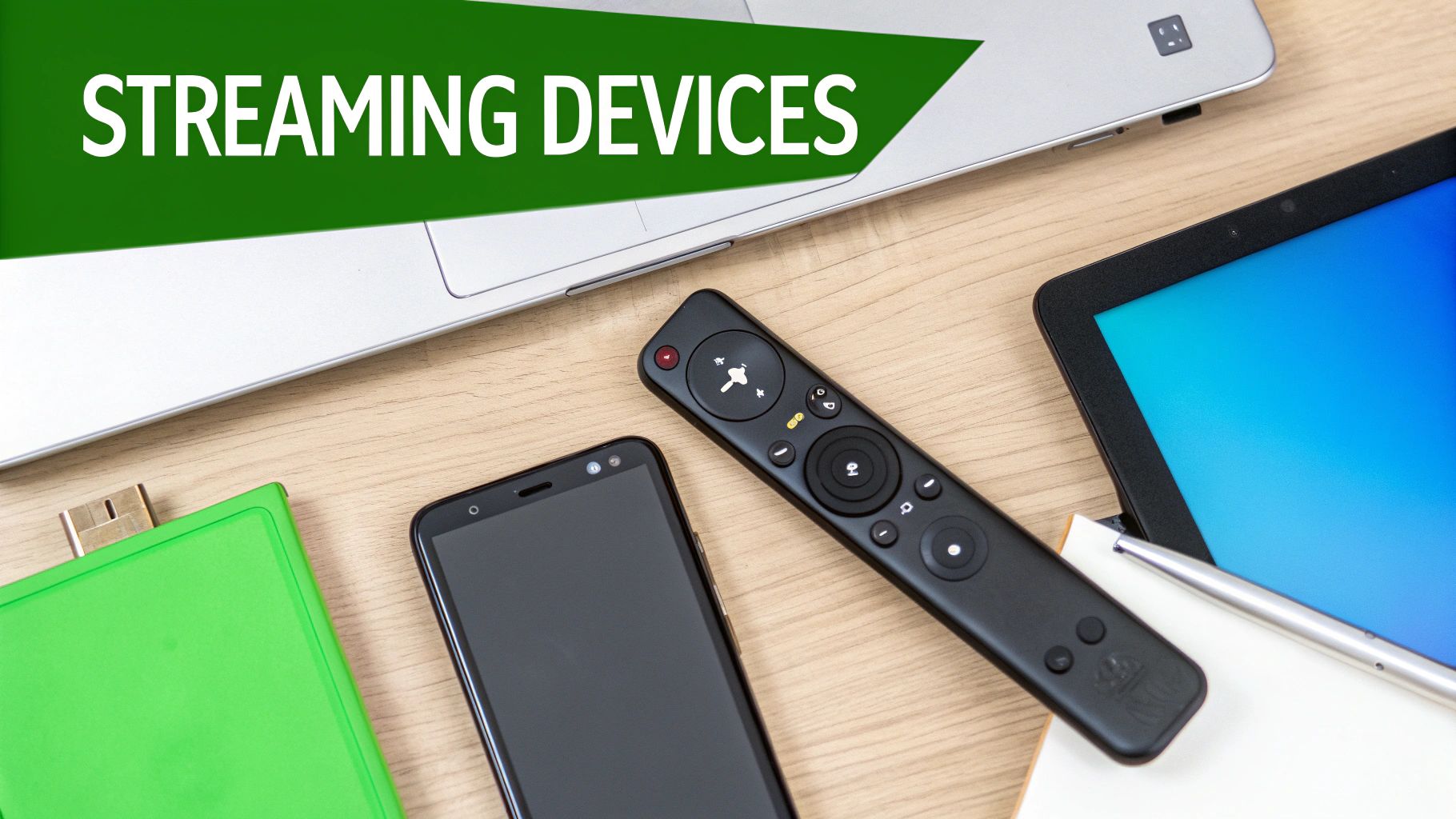
Next up, you need something to actually play the stream on your TV. The great news? You probably already have one. Most modern smart TVs have apps built right in, but I've found that a dedicated streaming device often gives you a snappier, more intuitive experience.
Some of the most common gadgets people use are:
To really dive into live TV, you'll need the right hardware and, just as importantly, the right software. For anyone using an Android device, it’s worth checking out the best streaming apps for Android to find a player that suits your style.
Okay, last piece of the puzzle. You need a way to actually access the channels. This is where an IPTV player and a playlist enter the picture. The player is the program that plays the stream, and the playlist (which is usually an M3U file) is simply the list of available channels.
Our free online player makes this dead simple by letting you stream right in your browser—no downloads required. All you need is a playlist from one of the best IPTV providers, and you'll have thousands of channels at your fingertips instantly.
Think of an IPTV player as your personal passport to a world of television, completely tearing down the geographical walls of old-school cable. It’s less like a channel-surfing remote and more like a special kind of web browser built just for TV streams. Instead of typing in a website, you just load up an M3U playlist.
That playlist is basically a simple text file, but it acts like a super-powered channel guide. It's filled with links to live streams from all over the planet, giving you a direct line to whatever you want to watch. Our free online player uses this simple but incredibly effective method to open the door to thousands of international, local, and niche channels that regular cable companies could never dream of offering.
The real magic behind this global access is the M3U playlist. Because it's just a plain text file, it's unbelievably flexible and a breeze to manage. You can find playlists built around specific countries, languages, or even genres like sports or movies. This puts the power in your hands to build a channel lineup that's perfectly tailored to what you love.
If you're feeling adventurous and want to peek behind the curtain, you can even learn how to create your own M3U playlist with our step-by-step guide. This level of customization is what modern streaming is all about.
An IPTV player turns the vast, global network of live TV into a manageable and personalized library. You're no longer limited by what a local cable company decides to offer; you're in complete control.
This kind of flexibility also brings some serious financial perks. When you curate your own content, you stop paying for hundreds of bundled channels you never even watch. The shift to live streaming is a huge global trend, with the market expected to hit around $247 billion by 2027. Consumers everywhere are moving toward real-time, on-demand content.
This new model doesn't just save you money; it puts you in the driver's seat. Maybe you're an expat who misses TV from home, a language student looking to immerse yourself, or a die-hard sports fan following a league on the other side of the world. Whatever your reason, an IPTV player is the key that unlocks it all.
More than anything else, live sports are the big reason millions of people are finally cutting the cord with cable. For so many fans, sports are the "killer app" for live TV streaming. It's just an unbeatable way to follow your favorite teams from anywhere, on pretty much any device you own.
You don't have to take my word for it—the numbers are staggering. Live sports streaming is a massive growth engine, especially in huge markets like India, the UK, and Australia. In 2025, the global sports streaming market is valued at a whopping $33.9 billion, and it's not slowing down. Just look at the Indian Premier League (IPL) 2025 final, which pulled in a record 578 million digital viewers in the first innings alone. You can learn more about these powerful sports streaming market trends and see exactly how viewership is shifting online.
It's not just about the big leagues, either. Streaming has thrown open the doors for countless niche sports that used to fight for a sliver of airtime on broadcast TV. Think about things like international cricket, rugby, and even darts—they now have dedicated global followings, all because IPTV makes it so easy to tune in. This tech connects fans directly to the action they actually care about, no matter how specialized.
For any true sports nut, a good IPTV player is an essential piece of kit. It’s your gateway to a nearly endless supply of live games and matches from every corner of the globe. You'll never have to miss a crucial moment just because of where you happen to live.
The real magic is the ability to follow your passion without limits. Whether it's a local college game or an international final, live TV streaming puts you right in the center of the action.
And the flexibility goes beyond just watching live. Many services now pack in features that make the whole experience even better. For example, our guide on IPTV with catch-up features breaks down how you can watch games you missed, completely on your own schedule. This mix of live access and on-demand convenience is what makes streaming the clear winner for sports fans.
Once you start digging into live TV streaming, a few questions always seem to pop up. Let's get them answered so you can stream with total confidence.
The big one is always about legality. So, let's be crystal clear: the technology itself and using an IPTV player is 100% legal. Big names like YouTube TV and Sling TV are built on this exact model. The real question is where your content comes from. As long as your playlists are from official, licensed providers who have the rights to broadcast the channels, you're completely in the clear.
This is a common myth. You don't need a crazy-fast, top-of-the-line internet plan. What you really need is a stable connection. Consistency is way more important than raw speed because it prevents that dreaded buffering right when the game is on the line.
Here’s a quick cheat sheet for bandwidth:
Think of it like a steady flow of water through a pipe. A consistent stream of data is the secret to buffer-free viewing. It's not about a massive gush of speed all at once, but a smooth, uninterrupted flow.
Another question I hear a lot is about local channels. Can you still watch your local news or network shows? Absolutely. Most of the major streaming services include them based on where you live. You can also find M3U playlists that provide legal access to local broadcast streams, which you can pop right into a free IPTV player like ours. It’s the perfect way to stay connected to your community without needing an antenna or cable box.
Ready to take control of your viewing experience? The Free IPTV Player lets you stream any M3U playlist directly in your browser, no downloads needed. Get started today.